From Pcells to performance: why direct layout migration is better for analog circuits

Why preserving layout, not rebuilding, is the key to scalable analog migration

When migrating analog layout between foundries or process nodes, the work is often perceived as complex. Analog circuits can be described as overly sensitive, fragile, or difficult to transfer reliably, but that view misses the key insight: well-designed analog circuits are inherently robust, and direct layout migration leverages that robustness effectively.


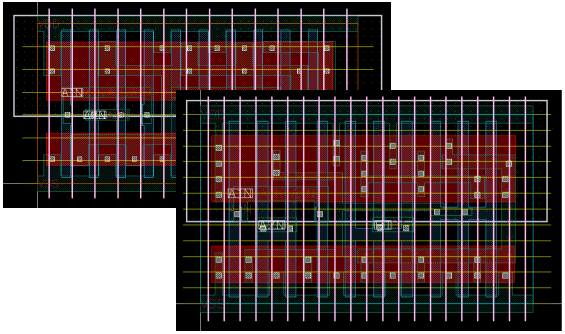
Analog circuits are built to withstand manufacturing variation. Designers account for process, parasitic, and environmental differences through symmetry, common-centroid placement, device matching, and conservative margins. These strategies create inherent resilience, which is precisely what makes direct layout migration so effective. Unlike migration through schematics, direct layout migration preserves placement, routing, matching structures, shielding, and non-active geometry, retaining the physical implementation of design intent that has already been proven in silicon. Much of what makes an analog circuit perform well is embedded in the layout itself, not captured by the schematic.


A key advantage of direct layout migration is that it preserves the layout hierarchy. By keeping the original hierarchical structure intact, very large circuits can be migrated efficiently without flattening or rebuilding them at the device level. This is a major differentiator compared to schematic-driven migration tools, which often focus on device sizing algorithms with little consideration for the existing layout. Those approaches require re-deriving the entire layout, re-optimizing placement, and rerouting connectivity, an effort that scales poorly for large analog blocks. In contrast, hierarchical layout preservation allows entire complex modules, such as serdes or wireless IP, to move between processes while retaining their proven connectivity, symmetry, and matching. 
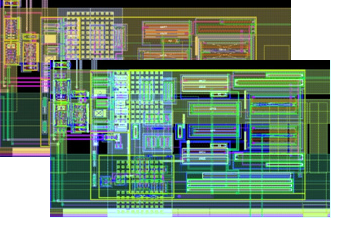

By preserving the layout, engineers can take device sizing decisions based on accurate extracted parasitic data rather than schematic estimates, as post-layout simulation with extracted parasitics remains the ultimate safety net. Any physical differences introduced during migration—whether due to rule-driven adjustments, layer mapping, or minor device reconstruction—are captured in simulation, ensuring the migrated layout meets electrical specifications before tapeout. The main challenges in migration are therefore not due to circuit fragility, but rather to reconciling the new process constraints while maintaining symmetry, placement, routing, and hierarchy. For analog layouts, retaining the original geometry and hierarchy is more valuable than rebuilding devices from parameters, because the original layout embodies silicon-validated tuning and design decisions.


In essence, direct layout migration allows designers to carry forward proven design decisions, physical tuning, and layout expertise, while post-layout simulation ensures correctness in the new process. Tuning the circuit by adjusting component sizes can be applied directly to the layout and specifications met through accurate simulations with physical data.  By preserving the layout hierarchy and the implementation that already works, this approach avoids the time, effort, and uncertainty of schematic-driven redesign. Rapid and direct layout migration takes engineers to simulation of a real circuit and tape-out.


In an era of multi-foundry strategies and continuous node evolution, direct layout migration is not just efficient, it's a clear competitive advantage.

8 January 2026
For analog IP reuse, the layout is the source of truth
31 October 2025
Why PDKs Are the Next Frontier for IP Theft
by Bronte Hobson-Scott 7 August 2025
IN2FAB Talks Semiconductors at UMaine’s Semiconductor Camp
2 April 2025
Photonics and the Tech Race: Safeguarding National and Corporate Security in the Battle for Dominance
13 January 2025
Unsecured PDKs and Pcells are a major security risk
by VF1935 25 October 2024
Driving Circuit Migration and PDK Security in the Microelectronics Commons
19 March 2024
Automated modifications to standard cell libraries saves time and money
13 December 2023
Rapid porting accelerates SoC development using existing cores or 3rd party IP.
by VF1935 16 August 2023
IN2FAB to add DFM capability to OSIRIS tools with support from Innovate UK
25 June 2023
Database translation tools enable rapid circuit integration